Petrified Forest National Park guide · 1 min read
Puerco Pueblo and the Solstice Petroglyph
Puerco Pueblo sits eleven miles in from the park's north entrance and seventeen miles from the south one.
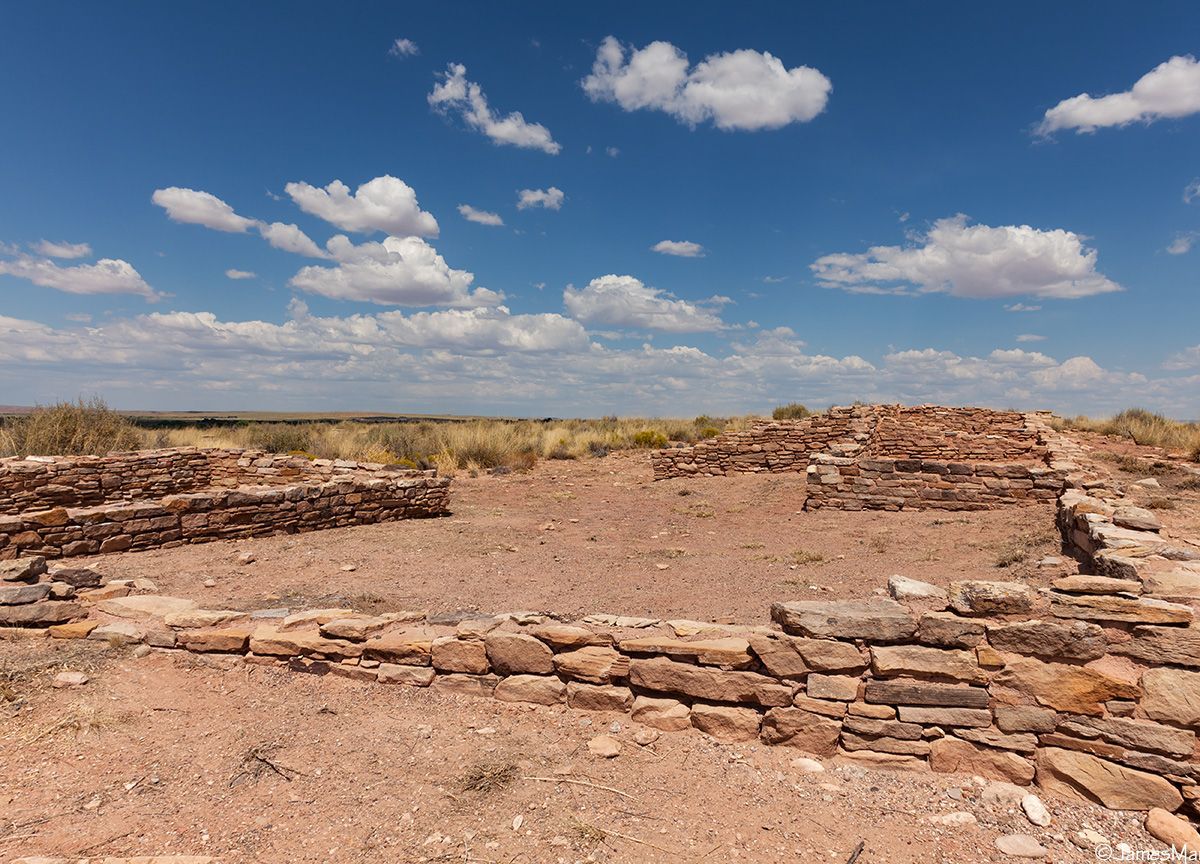
A paved trail, three-quarters of a mile long, runs through the site, and most of what survives is a set of masonry walls from a hundred-room pueblo that Ancestral Puebloan people occupied more than 600 years ago.
Some of the rooms lacked both windows and doorways. Residents got in from above, using a ladder to reach an opening in the roof. At the height of its occupation, roughly 200 people may have lived here, and the stone walls still form the rectangular shapes of its connected rooms.
In the centuries that followed, many families moved away and joined growing towns on the Hopi Mesas in northern Arizona and at Zuni Pueblo in New Mexico. Their descendants still live in those communities. Some researchers think ongoing dryness nudged people to leave, and the last residents departed around 1380.
Carvings are found along the trail's south end. The images were made by pecking, scratching, or carving into stone, many on a darkened coating called desert varnish. Researchers estimate that most of the park's petroglyphs date from between 650 and 2,000 years ago. Visitors should stay off the boulders and walls, and keep hands off the carvings.
The solstice petroglyph is a small spiral on a boulder reached from the trail. On the summer solstice, the rising sun lights the spiral and throws shadows across it, a light-and-shadow show that is one way the region's early peoples tracked the year with solar calendars like this one. Roughly halfway along the trail stands a mini museum in a building the Civilian Conservation Corps constructed, where exhibits explore the area's people, its archeology, and its past.