Parka
Castillo de San Marcos and Fort Matanzas National Monuments

Things to Do in Castillo de San Marcos and Fort Matanzas National Monuments

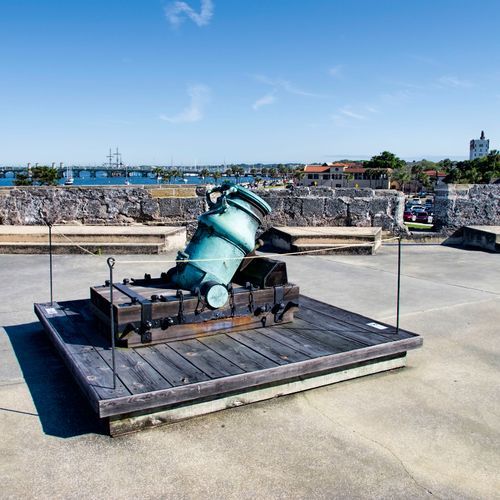
Few places on the Florida coast let you step so completely into the colonial past as this pair of Spanish strongholds, set about fifteen miles apart along the edge of St. Augustine. Start with the Castillo de San Marcos, the massive star-shaped coquina fortress raised between 1672 and 1695 to guard the oldest continuously occupied European city in the country. Walk the gundeck for sweeping looks over Matanzas Bay, poke into the shadowy vaulted rooms that once served as storerooms and barracks, and time your visit for a cannon firing demonstration, when costumed interpreters load and fire a period piece with a thunderous roar. Budget one to two hours here, and if you have kids along, the Junior Ranger program turns the visit into a hands-on adventure. Check the events calendar before you go, since living history weekends add soldiers in 18th-century dress and plenty of drama.

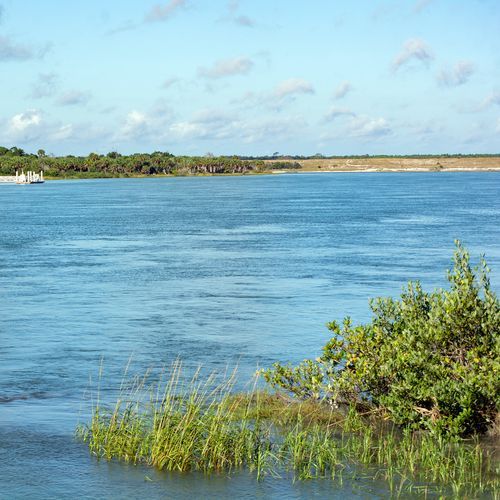
South along a gorgeous stretch of A1A, Fort Matanzas offers a quieter, wilder counterpart. A short, free ferry ride crosses the Matanzas River to a compact coquina watchtower finished in 1742 to protect the southern water approach to St. Augustine. A ranger narrates the crossing and the stark story behind the name, rooted in the 1565 killing of some 250 French colonists by Spanish forces. Once on the island, squeeze up the narrow ladder to the top of the tower, where the panorama of inlet, salt marsh, and open water looks much as Spanish sentries would have seen it. Keep watch for dolphins rolling in the channel, ospreys hunting overhead, wading birds working the shoreline, and the occasional sea turtle. Ferry passes are handed out first come, first served at the visitor center and are often gone by late morning, the boat does not run on Tuesdays or Wednesdays, and some weekend trips include cannon demonstrations.

The Fort Matanzas grounds also protect roughly 300 acres of coastal Florida, which makes it easy to linger. Wander out to the undeveloped beach on the Atlantic side for shelling, birding, and long walks on sand that feels a world away from the busy town to the north, or bring a kayak to explore the calm inlet waters by paddle. A smart plan is to visit the smaller fort first and finish at the grand Castillo, letting the scale of each impress on its own terms. Round out the trip with nearby gems such as Washington Oaks Gardens State Park, with its formal gardens and unusual coquina rock shoreline, or Princess Place Preserve, home to an 1888 hunting lodge and peaceful wooded trails.

Point of interestCastillo de San Marcos

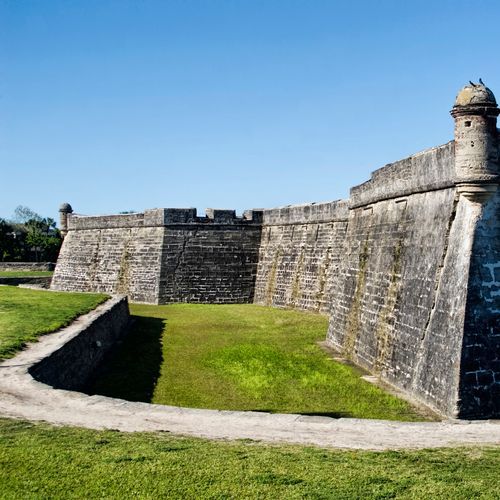
Spain built this coquina fortress between 1672 and 1695 to guard St. Augustine, replacing a string of wooden forts and helping shield the Gulf Stream routes used by treasure fleets. Diamond-shaped bastions jut from each corner of a square plaza, ringed by thick walls with cannon openings along the top. Outside, a water-filled moat, a triangular ravelin and a grassy sloped glacis surround the fort on three sides, with a water battery on the bay side.

Point of interestCastillo de San Marcos

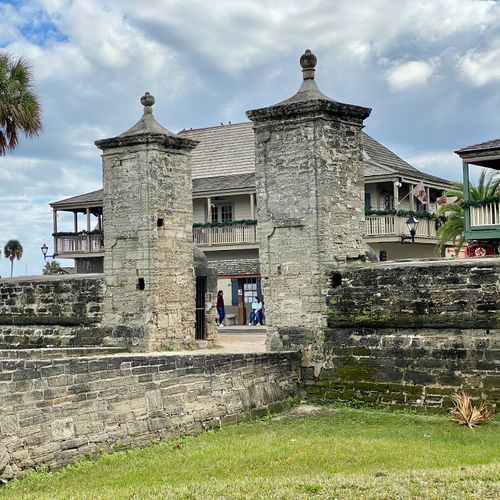
This gateway was built by the Spanish in 1808 when they rebuilt the town's northern wall, the Cubo Line, more than a century after the Castillo was finished. Having regained Florida from the British, they fortified St. Augustine against the Americans. Farmers passed through by day to trade crops, and the gate was locked each night. Restored stretches of the old town wall flank it on both sides.

Point of interestCastillo de San Marcos

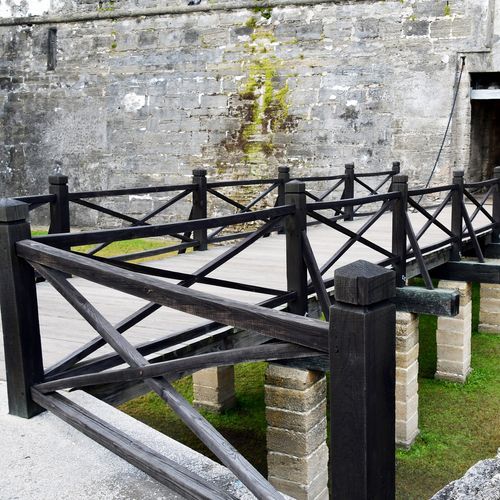
This triangular outwork sits in the moat just beyond the Sally Port, giving defenders a forward position to shield the fort's gate from direct attack. It is one of the original defensive features, along with the moat, covered way and glacis, that make up the historic grounds. Pause here on your way in or out to see how the outer defenses worked together with the nearby San Pedro and San Augustin bastions.

Point of interestCastillo de San Marcos

This reconstructed defensive wall once marked the innermost barrier protecting St. Augustine from attack by land. The Spanish began it in the early 1700s, after the English siege of 1702 showed the town needed more than the fort for protection. Linked with the Rosario Line, it helped enclose the colonial city. Today it stretches from the fort toward the nearby City Gate, and the view from the Castillo shows both together.

Point of interestFort Matanzas

Completed by the Spanish in 1742, this coquina watchtower on Rattlesnake Island guarded Matanzas Inlet, a back door to St. Augustine that bypassed the Castillo's defenses. Its shell-stone walls, sealed with plaster made from burned oyster shells, enclose a gun deck and the quarters where soldiers lived and ate together. Visitors arrive by boat from the nearby ferry dock and climb sturdy stairs where soldiers once used a wooden ladder.

Point of interestFort Matanzas

This dock beside the visitor center is the departure point for the free passenger ferry, the only way to reach Fort Matanzas, the 1742 coquina watchtower that guarded St. Augustine's southern approach. Every rider, including children and babies, needs a boarding pass picked up at the visitor center, and seats fill quickly, so arrive early. Each trip across the river includes a ranger-led presentation on the fort's story.

Point of interestCastillo de San Marcos

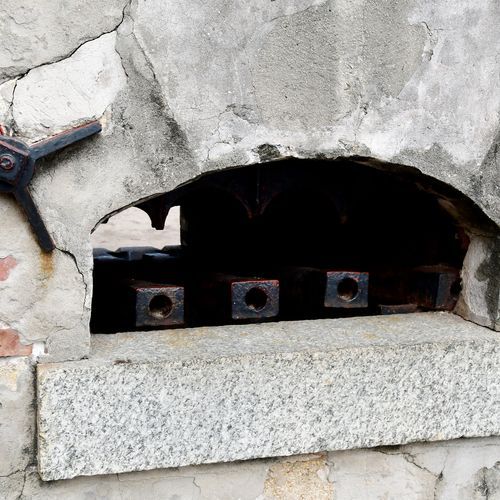
This furnace heated iron cannonballs until they glowed red, turning ordinary shot into fiery ammunition. Crews carried the glowing balls to the cannon's muzzle on a specially built iron barrow or a two-man litter. It was tense work in an era when powder charges came in cloth bags and any loose grains could flare up. That danger gave English the phrase "hot shot" for someone who draws trouble. It sits steps from the guard rooms and bastions.

Point of interestCastillo de San Marcos

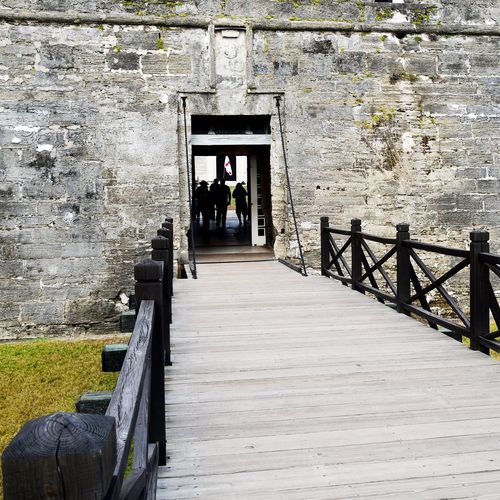
This fortified doorway is the main entrance into the Castillo, the passage visitors use to step from the outer defenses into the central courtyard. The Ravelin, an outwork that shielded this gateway, sits just outside, and the Guard Rooms where soldiers kept watch are right beside it. Pause here before heading on to the San Pedro Bastion and the other corners of the fort.

Point of interestCastillo de San Marcos

Just inside the fort's single entrance through the Sally Port, these rooms show how Spanish soldiers passed their off-duty hours. Most troops lived with their families in town and walked to the fort each day, but those posted on overnight watch stayed here to rest, cook meals, talk and play games. A locked room nearby once held the town jail, and the space now used as the bookstore was part of the officers' quarters.

Point of interestCastillo de San Marcos

One of four diamond-shaped bastions projecting from the corners of the fort, this angled platform was built to hold cannon and to cover the neighboring walls with crossfire. Like the rest of the Castillo, it is made of coquina, a shell stone quarried on Anastasia Island. From the top you can see how the star-shaped layout let defenders fire along the curtain walls, and the sally port, ravelin and hot shot furnace are a short walk away.

Point of interestCastillo de San Marcos

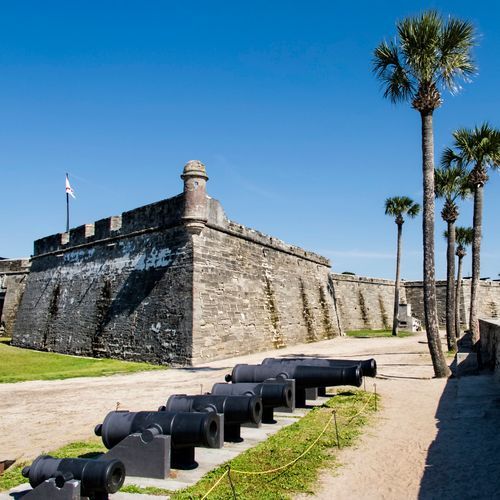
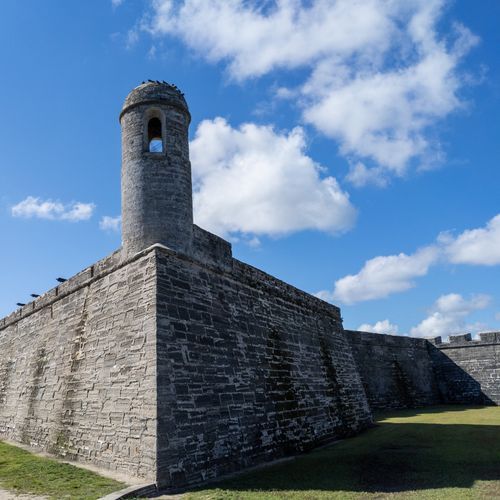
The fort's northeast corner holds this diamond-shaped bastion, the first part of the stone fortress the Spanish finished so cannon could be mounted on its upper deck in the 1670s. Its tall tower once held a bell that rang out to warn townspeople of approaching attacks. From here you can see the adjoining east wall, which the Spanish lowered so more guns could face the water, where they expected most threats to come from.

Point of interestCastillo de San Marcos

One of the four diamond-shaped bastions that form the corners of the Castillo, this projecting point sits close to the Sally Port and the Ravelin guarding the fort's entrance. Its angled walls, built of coquina quarried on Anastasia Island, let defenders sweep attackers with crossfire, while cut-outs in the parapet sheltered cannon and their crews. It's a good place to see how the star-shaped design worked.

Point of interestCastillo de San Marcos

One of four diamond-shaped bastions jutting from the corners of the coquina fort, this angled point let Spanish gunners sweep the approaches and catch attackers in crossfire. Cannon sat in embrasures, notches cut into the protective parapet walls. It stands close to the Sally Port entrance, the guard rooms and the ravelin, with the hot shot furnace just beyond, so it fits easily into a loop around the fort.

Discover more activities and plan your visit in the Parka app

Download Parka — It's Free

Take it with you

The Parka app keeps your maps, trails and plans working with no signal. What you save here is already there.

Download on the App Store

Explore All 83 Parks

Browse parks by region and discover your next adventure