Death Valley National Park guide · 1 min read
Racetrack Playa and Sailing Stones
Racetrack Playa is a dry lakebed in a remote valley between the Cottonwood and Last Chance Ranges.
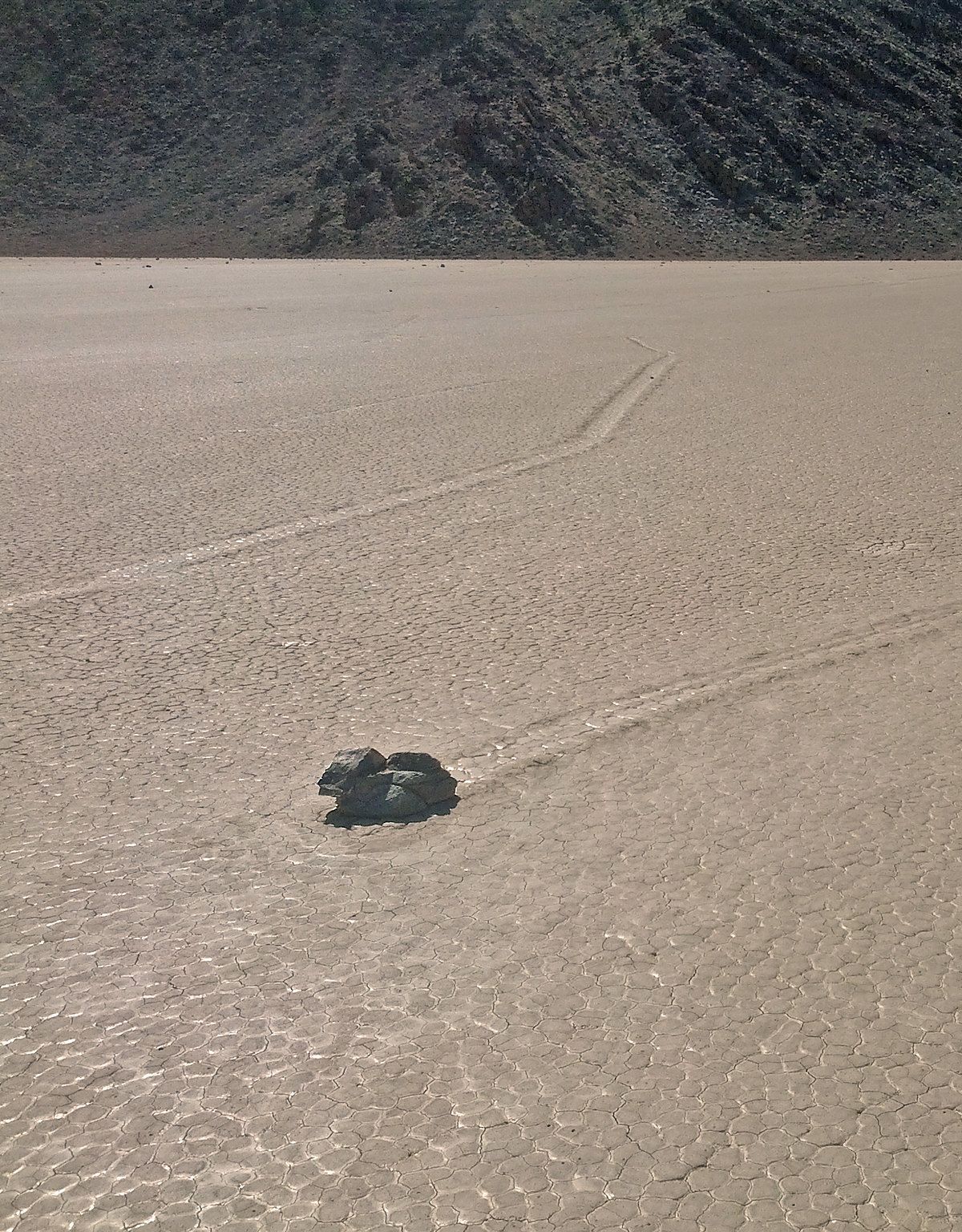
It is best known for its sailing stones, boulders that glide across the flat surface and leave trails that can stay visible for years. For a long time, no one could explain how the rocks moved.
Getting here takes planning. The route covers 27 miles of rough, unpaved backcountry road that begins at Ubehebe Crater in the northern part of the park. A high-clearance vehicle is required, and a four-wheel-drive is recommended. Gravel and sharp rocks cover much of the surface, so flat tires are common. You will pass Teakettle Junction on the way.
Once you reach the playa, park in one of the dirt pullouts along the road. A fairly flat dirt path leads out onto the lakebed toward the rocks, though the unmarked route may cross narrow bushes and natural desert obstacles. The rocks cannot easily be seen from the car, so plan to walk out. There are no restrooms at the site; the closest is at Grapevine Ranger Station, 33.2 miles away.
Please avoid walking on the playa when it is wet. Footprints left on the soft surface can scar it permanently.
Scientists have studied the rocks closely. A group of friends formed the Slithering Stones Research Initiative, collecting rocks to fit with GPS instruments and tracking their movement. Two physicists from Boise State University, Ralph Lorenz and Brian Jackson, got involved while studying dust devils and other desert weather features. Research on the playa points to floating ice as a strong driver of rock motion. In one study, the team recorded five move events during the roughly two and a half months a pond existed on the playa, and some of those events involved hundreds of rocks.