Wildlife · Bird · Zion National Park
Red-tailed Hawk in Zion National Park
In Zion National Park, the Red-tailed Hawk is recorded most often in Zion Canyon. Most sightings are recorded from October through April, with the most in November.
Where can you see Red-tailed Hawk in Zion National Park?
Near Big Bend Viewpoint
Zion Canyon · about 0.2 mi away · 279 recorded sightings · Open in Maps
Near Big Bend Viewpoint
Zion Canyon · about 0.5 mi away · 69 recorded sightings · Open in Maps
A viewing spot is a place where visitors have photographed and reported the animal many times. Wild animals move: a spot raises your chances, it doesn't promise a sighting. Keep the distance the park asks for.
When is the best time to see Red-tailed Hawk in Zion National Park?
Most sightings are recorded from October through April, with the most in November.
- January: 15 sightings
- February: 17 sightings
- March: 21 sightings
- April: 20 sightings
- May: 12 sightings
- June: 10 sightings
- July: 17 sightings
- August: 28 sightings
- September: 3 sightings
- October: 43 sightings
- November: 58 sightings
- December: 23 sightings
Recorded sightings in Zion National Park by month, 267 in all. The count follows visitors as well as animals: a quiet month can mean few people were there to report.
Key facts
- Type
- Bird
- Scientific name
- Buteo jamaicensis
- Mapped viewing spots
- 2
- Most sightings
- October through April
- Recorded sightings
- 267
About the Red-tailed Hawk
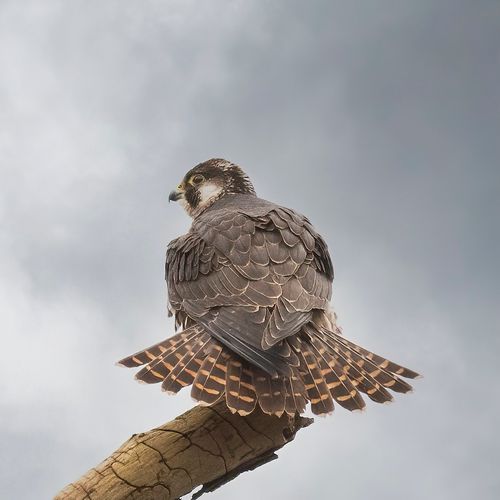
A large, broad-winged raptor, the red-tailed hawk measures about 18–26 inches long with a wingspan of roughly 3.5–4.5 feet and weighs about 1.5–3.5 pounds; females are about 25% heavier than males. It has a stocky body and a distinctive brick-red tail visible from above and a pale buff-orange below, plus a pale belly often marked with a dark belly band. In flight you’ll notice its broad, rounded wings and a soaring, steady wingbeat that sets it apart from slimmer hawks.
You’ll find red-tailed hawks across open country — from deserts and grasslands to parks, roadsides, agricultural fields and even city edges — though they avoid unbroken deep forest and the high Arctic. They hunt from high perches or while soaring, scanning for small mammals, birds and reptiles, then swooping down to grab prey with powerful talons. Pairs often mate for life, build large stick nests in tall trees or on cliff ledges, and lay one to three eggs. Listen for the classic, raspy scream frequently used in films; it’s a loud, carrying call that announces territory and presence.
Red-tailed hawks remain common and are protected by law in the U.S., Canada and Mexico, so sightings are a likely highlight for park visitors. Their feathers hold cultural significance for many Indigenous peoples, and their adaptability makes them a familiar, striking part of the landscape. If you spot one, enjoy the view from a distance and avoid disturbing nests or young.